AI Guardrails Explained: The Safety Nets Behind Chatbot Responses
How AI guardrails actually work to keep chatbot outputs safe and appropriate, what techniques they use, and why they aren't a perfect solution.
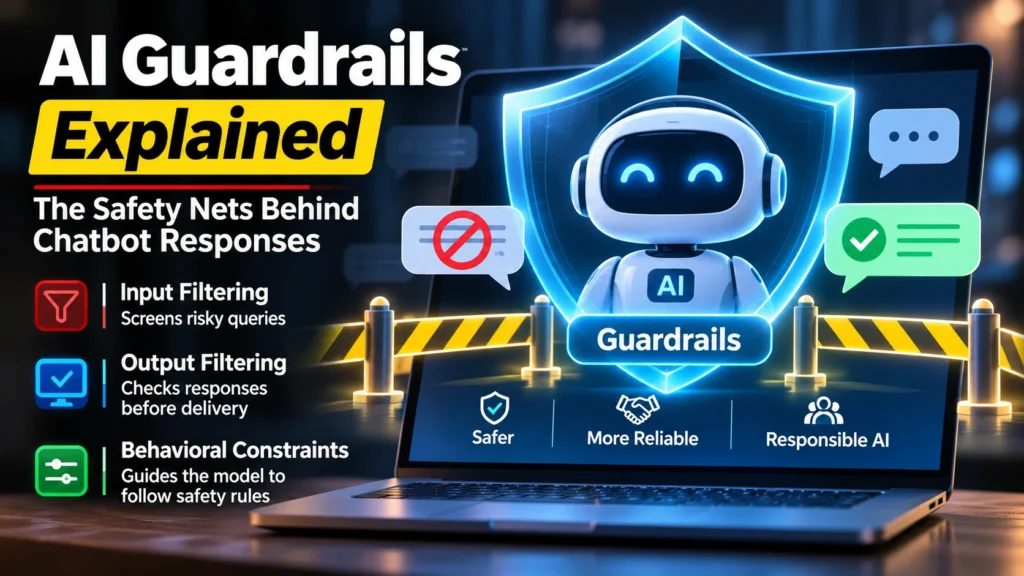
AI guardrails are the practical technical safeguards built around AI models, including content filtering systems, output monitoring, and behavioral constraints, specifically designed to prevent an AI system from generating harmful, inappropriate, or otherwise unwanted outputs, functioning as a practical safety layer that complements a model’s underlying training-based alignment.
Why Guardrails Exist Alongside Model Training Alone
Even a carefully trained AI model that’s generally well-aligned with intended values can still occasionally produce unwanted outputs due to unusual inputs, edge cases not well-covered during training, or deliberate attempts to manipulate the model into inappropriate behavior, which is why AI companies deploy additional guardrail systems as a practical safety net operating alongside a model’s underlying training, rather than relying entirely on training alone to guarantee consistently appropriate behavior.
Common Technical Approaches to Implementing Guardrails
AI guardrails typically combine several different technical approaches, including input filtering that screens user queries for policy-violating content before they even reach the underlying AI model, output filtering that reviews a model’s generated response before delivering it to the user, and specific behavioral instructions embedded directly into how a model is deployed, guiding it to decline certain categories of requests or follow particular response patterns for sensitive topics.
The Balance Between Safety and Helpfulness
Designing effective AI guardrails involves a genuinely difficult ongoing balancing act, since guardrails that are too restrictive can cause an AI system to unhelpfully decline entirely legitimate, benign requests that merely resemble a problematic pattern, while guardrails that are too permissive risk allowing genuinely harmful outputs through, a tension that AI companies continuously work to calibrate and refine as they gather more real-world usage data and feedback.
Why Guardrails Aren't a Perfect, Foolproof Solution
Independent security researchers have consistently demonstrated that determined users can sometimes find ways to circumvent AI guardrails through carefully crafted prompts, a practice generally referred to as jailbreaking, meaning guardrails function as a meaningful but imperfect safety layer that reduces the likelihood of unwanted outputs rather than providing an absolute, unbreakable guarantee against every possible attempt to elicit inappropriate behavior from an AI system.
How Guardrails Continue to Evolve Over Time
AI companies continuously refine their guardrail systems based on real-world usage patterns, newly identified circumvention techniques, and evolving policy considerations, meaning the specific guardrails protecting a given AI system today generally differ, and are usually more sophisticated, than what protected an earlier version of the same system, reflecting guardrails as an ongoing, iteratively improved safety practice rather than a fixed, one-time implementation.
Bottom Line
AI guardrails are practical technical safeguards, including input and output filtering and embedded behavioral instructions, that work alongside a model’s underlying training to prevent harmful or inappropriate outputs, representing an important but imperfect safety layer rather than an absolute guarantee. AI companies continuously refine guardrail systems in response to real-world usage patterns and newly discovered circumvention techniques.
Sources
- AI guardrail and content moderation system technical documentation from major AI companies
- Independent security research on AI jailbreaking and guardrail circumvention techniques
- AI safety research on balancing helpfulness against restrictive safety measures
- Industry analysis of AI guardrail evolution and iterative improvement practices