AI Safety Explained: The Broader Effort Behind Responsible AI
What AI safety research actually covers beyond alignment, why it matters as AI systems grow more capable, and how major labs approach it in practice.
AI safety is the broad field of research and practical engineering work focused on ensuring AI systems operate reliably, avoid causing unintended harm, and remain robust against misuse, encompassing AI alignment as one important component alongside additional concerns like security, robustness, and managing broader societal risks from increasingly capable AI systems.
What AI Safety Actually Encompasses
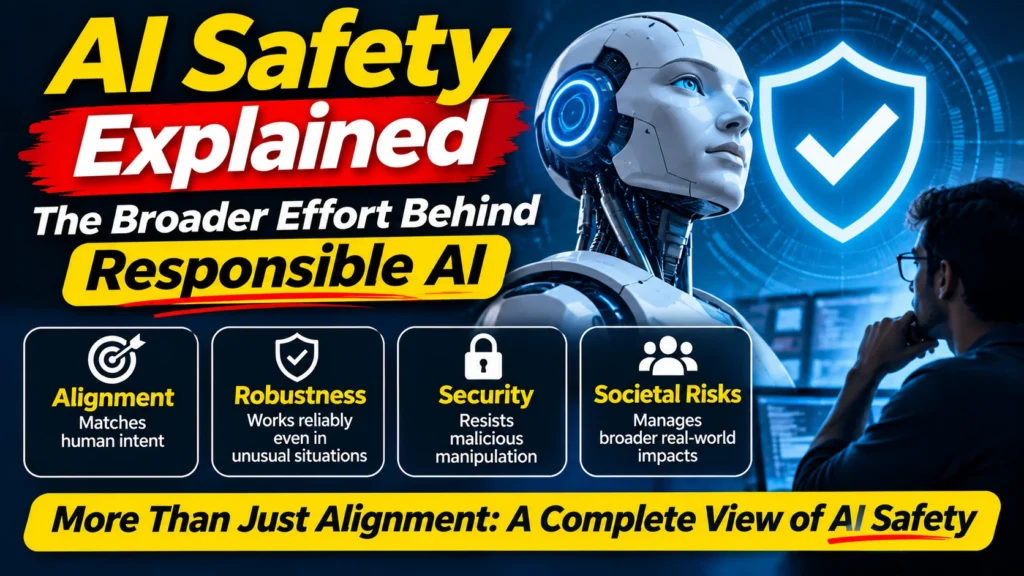
AI safety research spans several distinct but related concerns, including alignment, ensuring a system’s behavior matches genuine human intent, robustness, ensuring a system behaves reliably and predictably even when facing unusual or adversarial inputs, security, protecting AI systems from malicious manipulation like prompt injection attacks, and broader risk management addressing potential large-scale societal, economic, or safety consequences that could emerge from increasingly capable and widely deployed AI systems.
Why Robustness Matters as Much as Good Intentions
An AI system that’s well-intentioned and generally well-aligned with human values can still cause real problems if it behaves unpredictably or fails in unexpected ways when encountering unusual situations, ambiguous inputs, or deliberate adversarial manipulation attempts, which is why AI safety research places considerable emphasis on robustness testing, deliberately probing AI systems with unusual or challenging inputs specifically to identify and address failure modes before real-world deployment.
How Major AI Labs Approach Safety in Practice
Prominent AI labs have generally established dedicated internal safety research teams, extensive red-teaming processes where specialists specifically attempt to find ways an AI system could be misused or could fail unexpectedly, and staged deployment approaches that gradually expand a new AI system’s availability and capability while monitoring for safety issues, practical safety engineering approaches that complement more theoretical alignment research with concrete testing and risk mitigation practices.
Why AI Safety Concerns Have Grown More Prominent
As AI systems have become more capable and have been integrated into an expanding range of consequential real-world applications, from healthcare to financial services to critical infrastructure, the potential real-world impact of AI safety failures has grown correspondingly, driving increased research investment, growing regulatory attention, and more prominent public discussion around ensuring AI systems are developed and deployed responsibly as their capability and real-world influence continue expanding.
The Ongoing Debate Around AI Safety Priorities
AI safety remains an area with genuine ongoing debate among researchers, industry practitioners, and policymakers regarding which specific risks deserve the most urgent attention, ranging from more immediate practical concerns like misinformation and biased outputs to longer-term, more speculative concerns about highly advanced future AI systems, a debate that reflects genuine uncertainty about how AI capability will continue to develop and what specific safety measures will prove most important going forward.
Bottom Line
AI safety is the broad field addressing AI alignment, robustness, security, and broader societal risk management, encompassing both theoretical research and practical engineering measures like red-teaming and staged deployment used by major AI labs. As AI systems have grown more capable and widely deployed across consequential applications, AI safety has become an increasingly prominent area of research, industry practice, and regulatory attention.
Sources
- AI safety research documentation from major AI labs and research organizations
- Independent analysis of AI red-teaming and staged deployment practices
- AI robustness and adversarial testing technical documentation
- Industry and regulatory analysis of AI safety policy development