AMOLED Display Explained: What the ‘Active Matrix’ in AMOLED Actually Does
Why smartphones use AMOLED instead of plain OLED, what the active matrix TFT backplane actually controls, and how Super AMOLED and Dynamic AMOLED branding differs.
Part of our Smartphone Chips and Displays: The Complete Buying Guide guide.
Scroll through a phone’s spec sheet and an AMOLED display usually shows up rather than plain OLED, especially on Samsung devices. The two terms get used almost interchangeably in casual conversation, but the difference between them explains a genuinely important piece of engineering, one that had to be solved before OLED technology could ever fit into a smartphone in the first place.
The One Word That Changes Everything: Active Matrix
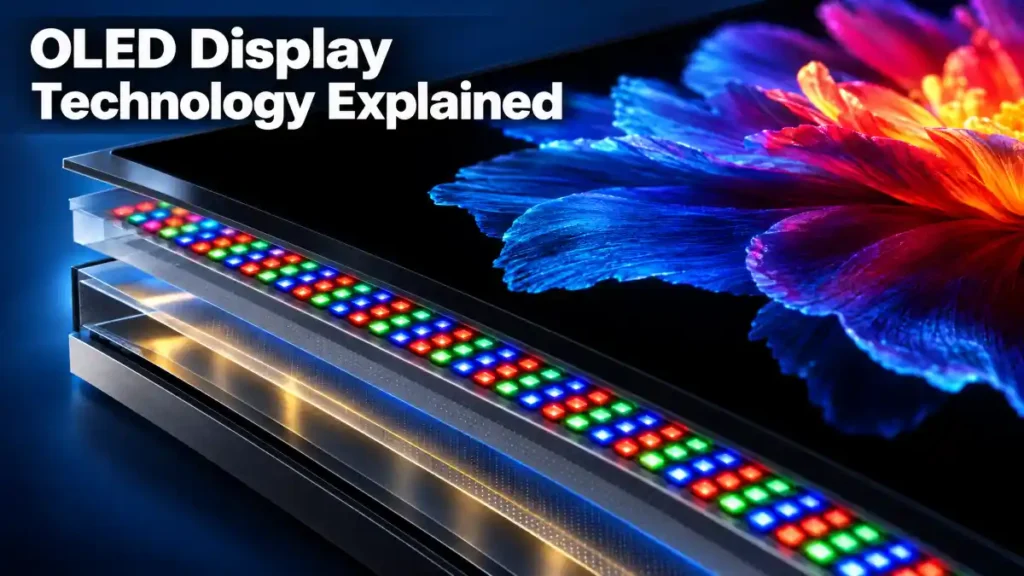
OLED is the underlying light-emitting technology: organic compounds that produce their own light when current runs through them. An AMOLED display, or active-matrix organic light-emitting diode display, describes how those pixels get switched on and off. Behind every AMOLED panel sits a layer of thin-film transistors, often shortened to TFTs, paired with tiny storage capacitors. Each pixel gets its own transistor and capacitor, which lets the display control that single pixel’s brightness precisely and continuously rather than pulsing it briefly and moving on.
This matters because the earliest OLED products, things like small secondary phone displays and MP3 player screens in the 2000s, used a simpler passive-matrix approach with no per-pixel transistor. Passive-matrix OLED, or PMOLED, addresses pixels row by row rather than individually, which works fine for small, low-resolution, mostly static displays but breaks down completely at smartphone resolutions. Pushing a PMOLED panel to the pixel density and refresh speed a modern phone screen needs would require voltages high enough to wear the organic material out far faster than acceptable. The active-matrix backplane in an AMOLED display solved that problem, which is the entire reason it became the default OLED implementation the moment phone screens needed real resolution.
Samsung's AMOLED Naming Maze
Shopping for a Samsung phone means running into a string of related terms: AMOLED, Super AMOLED, and Dynamic AMOLED. These are not competing technologies so much as branded refinements of the same active-matrix foundation. Super AMOLED integrates the touch-sensing layer directly into the display stack instead of adding it as a separate layer on top, which makes the screen thinner and improves how the display looks in bright sunlight. Dynamic AMOLED and its successors build on that further with reduced blue-light output and a wider color range. None of this changes the underlying active-matrix mechanism described above. It is the same TFT backplane wearing different marketing names as Samsung refines the stack generation over generation.
What This Means in Daily Use
The active-matrix design does more than just make high resolution possible. Because each pixel has its own dedicated transistor, an AMOLED display can switch states faster than earlier OLED implementations, which shows up as smoother scrolling, snappier touch response, and cleaner motion during gaming. It also gives manufacturers finer control over power delivery, since the display can dim or brighten individual regions rather than treating the whole panel as one block, which is part of why AMOLED phones tend to sip less battery when showing mostly dark content like a black wallpaper or a video with letterboxing.
Like any OLED variant, AMOLED panels still age. The blue subpixel in particular tends to degrade faster than red or green over years of heavy use, which is why very old AMOLED phones sometimes show a faint color cast in specific areas of the screen. Pixel-shifting routines and software-driven compensation built into recent operating systems have reduced how visible this becomes, but the underlying organic material still wears at different rates depending on how hard each pixel gets driven.
Bottom Line
AMOLED is not a rival to OLED. It is the active-matrix engineering that made OLED viable at smartphone resolutions in the first place, and virtually every OLED phone screen sold today is technically an AMOLED display under a different label. Seeing Super AMOLED or Dynamic AMOLED on a spec sheet means looking at Samsung’s branding for touch integration and color tuning layered on top of the same active-matrix foundation, not a fundamentally different display type.
Sources
- OLED-Info, PMOLED vs AMOLED technical comparisons
- Samsung display technology briefings
- Android Authority, AMOLED and OLED terminology explainers
- Independent long-term display aging and burn-in coverage