
Tesla Models Comparison 2026: Model S vs Model 3 vs Model X vs Model Y vs Cybertruck
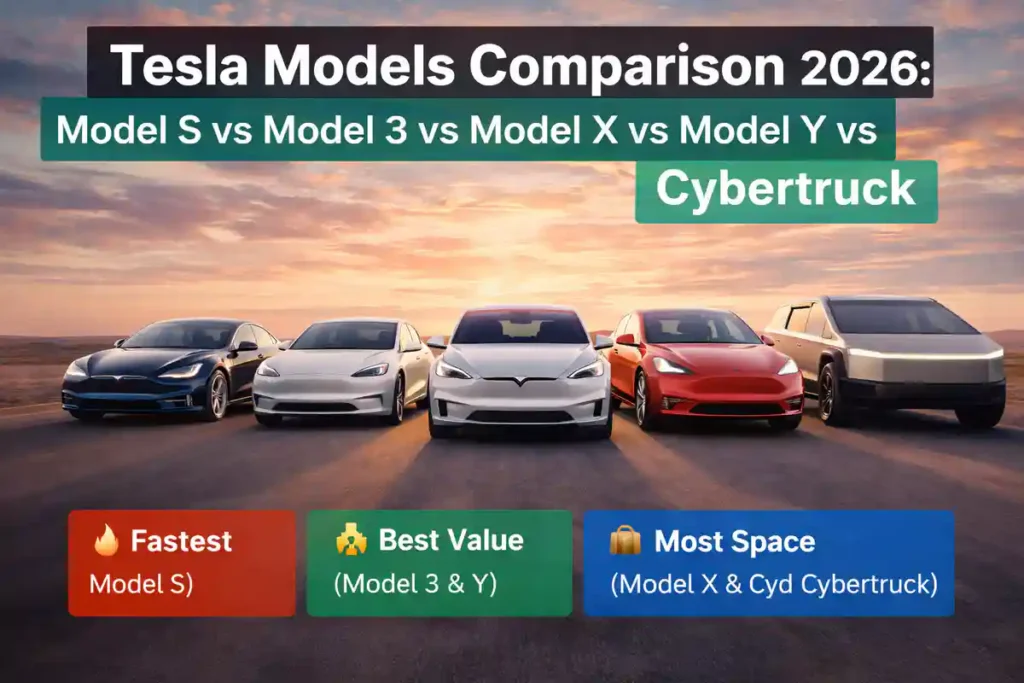
Part of our Phone and Laptop Brands Compared: The Complete Guide guide. The best “default” vehicle choices for the majority of consumers based upon the most...
Part of our Phone and Laptop Brands Compared: The Complete Guide guide.
The best “default” vehicle choices for the majority of consumers based upon the most common vehicle selection criteria can be determined using data from Tesla’s own website:
– The Model 3 Premium RWD provides the greatest estimated range at the lowest cost within the mainstream price tier (up to 363 miles EPA estimate per Tesla).
– The Model Y Premium RWD or AWD is the best option for families needing practicality and cargo flexibility; the Model Y offers up to 74.8 cu ft of cargo capacity and an optional third row on many configurations.
– The Model S non-plaid would be the best choice for those who need a high-end speed-luxury option for long distance travel (up to 410 miles EPA estimate per Tesla).
– The Model X is the best choice for those who require a 3-row seating, premium experience and have towing requirements (the Model X has a 5,000 pound trailer rating per Tesla’s specifications).
– The Cybertruck is the best choice for those requiring a pickup truck with capabilities (pickup class trade-offs including but not limited to, weight and mass impacting EPA estimates and how range estimates are reported).
Safety and reliability factors extend beyond crash test results; in addition to the hardware used in crash testing, 2024–2026 saw several recalls involving both software and components (hood latch detection, rear view camera display, power steering assist on select Model 3/Y vehicles and Cybertruck accelerator pedal trim).
Data notes and source hierarchy
Assuming the U.S. market this Guide will prioritize:
– Official spec pages of Tesla (prices, trims, EPA-estimated range, quoted 0-60 times by Tesla, cargo, towing, and “miles added in 15 minutes” charging claims)
– Published EPA test data at FuelEconomy.gov (kWh/100 miles efficiency, MPGe, and EPA estimated ranges per model year)
– IIHS ratings and awards (safety)
– Campaign documentation and Tesla’s Recall Support Pages (Recalls)
– Why it matters and context from credible reviews of road tests and specs (specifically Car & Driver, and Motor Trend).
Practical Note:
Tesla’s stated acceleration may be different than magazine-instrumented testing due to differences in test methodology (i.e. how the car is rolled off the starting line).
Car & Driver often includes a footnote to indicate whether they omitted the 1-foot rollout in their test table.
Model-by-model analysis
Model 3
The 2026 Tesla Model 3 is an “efficiency-and-value” product that provides the lowest-cost, most efficient-per-mile experience of all the Teslas, and has been the best of the lot for daily driving feel and “miles-per-kwh” feel.
It generally does not have the rear seat space or cargo height of the Model Y.
In terms of configuration/trims, Tesla offers the Model 3 in a four-trim ladder:
- Base (Rear Wheel Drive),
- Premium (RWD),
- Premium (AWD) and
- Performance (AWD).
Acceleration (0–60 mph):
Base Rear-Wheel Drive: 5.8 seconds
Premium Rear-Wheel Drive: 4.9 seconds
Premium All-Wheel Drive: 4.2 seconds
Performance AWD: 2.9 seconds
Range (Specify: EPA est.):
Tesla lists the largest EPA-estimated range as Premium Rear-Wheel Drive (up to 363 miles);
Premium AWD (up to 346 miles); and Performance (up to 309 miles);
and the Base Rear-Wheel Drive (321 miles).
FuelEconomy.gov’s 2025 listings for the Model 3 Long Range RWD show 363 miles and 25 kWh/100 mi, aligning very closely with Tesla’s headliner for that configuration family.
Battery Capacity (kWh, when available):
Tesla does not publish the pack size on its consumer specification page, however there are several reliable tests and first looks that have reported:
– Car and Driver reports that usable capacity drops down to approximately 69.5 kWh for the 2026 base Model 3, and lists 70 kWh packs in their spec panel.
– Motor Trend describes the Premium Rear-Wheel Drive pack as approximately 80 kWh and the base as 69.5 kWh, and describes this as a “deliberate cost/range trade-off” for the entry model.
Charging (Level 2 AC and DC Fast / Supercharger):
– DC Fast: Tesla lists 225 kW maximum for the base Model 3 and 250 kW maximum for the higher trims. Additionally, Tesla provides “miles added in 15 minutes” estimates.
– AC Charging: Tesla’s onboard charger guidance lists 7.7 kW (32A) for the Model 3 Rear-Wheel Drive and 11.5 kW (48A) for the Model 3 Long Range.
Car and Driver’s 2026 Model 3 Standard spec panel also lists the peak charge rate of 11.5/225 kW (AC/DC) for that trim.
Pricing (MSRP range, US; Tesla pricing is dynamic via Tesla website):
Tesla’s compare tool snapshot lists prices include Destination/Order Fees per Tesla’s footnote:
– Model 3 Rear-Wheel Drive: $38,630
– Model 3 Premium Rear-Wheel Drive: $44,130
– Model 3 Premium All-Wheel Drive: $49,130
– Model 3 Performance AWD: $56,630
Cargo and Seating:
Tesla lists 24 cu ft cargo and 5 adult seating capacity across Model 3 configurations listed in the Model 3 spec section.
Key Tech/Features (Autopilot/FSD, Infotainment):
Car and Driver indicates that Model 3 comes equipped with Tesla’s Autopilot driver-assistance package as standard.
Higher autonomy capabilities are sold separately. As well, there have been multiple times when Tesla has changed the packaging of what features are enabled by default vs. gated behind FSD (Supervised).
MotorTrend, reporting on Tesla’s own pricing/trim change coverage states that some base trims had some driver-assistance features enabled by default and others were gated behind FSD (Supervised).
Safety Ratings:
– IIHS: The redesigned Model 3 earned IIHS award/rating attention for 2025–26; IIHS explicitly noted the Model 3 was redesigned for the 2024 model year and shows crash-test ratings applicable to 2025–26.
– NHTSA: FuelEconomy.gov’s 2025 Model 3 Long Range RWD “Compare Side-by-Side” page shows NHTSA crash test results as “Not Available” for that specific listing.
Common Issues/Recalls (High Signal, Recent):
There have been several recent recalls impacting Model 3 (in addition to other models) including:
– Rearview Camera Display / Computer Shorting Condition (NHTSA Campaign 25V-002; 239,382 units of the Model 3/Y/S/X by model-year scope in the report).
– Hood Latch Detection / Hood-Open Warning Logic (NHTSA Campaign 24V-554; 1,850,363 potentially included in the recall population).
The Model 3 may also be affected by larger “fleet” software recall activity, which is why it is essential to pay close attention to Tesla’s OTA update history.
Ideal Buyer Profile:
Model 3 buyers typically want:
– A Tesla with the least expensive entry price in the lineup and best-in-class efficiency-per-mile
– A sedan driving position and “more sporty” feel than the Model Y
– More faster charging and longer range options in the mid-priced electric vehicle segment.
Pros and Cons (2026 Take):
Pros: Strong EPA-estimated range for the money; Multiple Trims; Widespread Options for Tesla Charging Ecosystem (Superchargers + Adapters).
Cons: Rear seat packaging can appear cramped compared to Crossovers; Availability of Safety Ratings from NHTSA may lag the redesign cycle.
Notable updates 2024–2026
IIHS explicitly identifies a redesign for the 2024 model year, with 2025–26 crash-test ratings tied to that design.
MotorTrend and Car and Driver both document the 2025–26 “cheaper entry” strategy: a reworked base Model 3 with a smaller battery (~69.5 kWh) and lower peak DC rate (225 kW vs 250 kW on higher trims).
Model Y
Model Y is Tesla’s main-stream “do it all” compact SUV.
It offers higher seating position, more cargo, more family-friendly packaging options and (in some trims) optional third row seats at the trade-off of a less connected feel of a sedan.
Trim & Variant Options (U.S.)
As reported in the U.S. market overview, there are five different ways Tesla has positioned its products:
- The Standard RWD, Standard AWD, Premium RWD, Premium AWD, and Performance AWD. Third row availability will depend on the chosen version and/or configuration.
0 – 60 mph Performance (Specified by Trim)
Based on Tesla quoted data for 0 – 60 mph performance:
– Standard RWD: 6.8 s
– Standard AWD: 4.6 s
– Premium RWD: 5.4 s
– Premium AWD: 4.6 s
– Performance AWD: 3.3 s
According to a Motor Trend review, Car and Driver tested a Premium AWD (previously known as Long Range AWD) and claimed the vehicle went 0 – 60 mph in 3.9 seconds.
They also noted the Performance could possibly go 0 – 60 mph faster than the 3.3 second figure provided by Tesla.
Range (Specifically: EPA estimate)
Range of Model Y is based upon trim and tire choice (as per EPA and Tesla Model Page):
– Standard RWD: 321 miles EPA Range (18-inch tire listed)
– Premium RWD: 357 miles EPA Range
– Premium AWD: 327 miles EPA Range
– Performance AWD: 306 miles EPA Range
Battery Capacity (kWh; when available)
Tesla does not provide the battery capacity of their packs in their Consumer Spec Pages, however Road Test Spec Panels have:
– An 81-kWh battery pack and maximum charge rate 11.5/250 kW for the 2026 Model Y Performance (according to Car and Driver).
– A battery pack with new chemistry and “more capacity (84 kWh)” according to Edmunds in their First Drive Review of the refreshed Performance Model.
(This is an example of how published numbers may differ by source (usable vs. gross, or measurement technique).
Charging (AC Level 2 and DC Fast/Supercharger)
– DC Fast: Tesla provides 225 kW maximum Supercharging for Standard RWD and 250 kW maximum for Premium and Performance, along with “miles added in 15 minutes” estimates by trim.
– AC Charging: According to Car and Driver’s Model Y Performance Spec Panel, AC charging capability is 11.5 kW (with 250 kW peak DC).
Price (MSRP Range; US)
According to Tesla’s US Pricing Snapshot:
– Model Y Standard RWD: $41,630
– Model Y Standard AWD: $43,630
– Model Y Premium RWD: $46,630
– Model Y Premium AWD: $50,630
– Model Y Performance AWD: $59,130
Cargo, Seating, Towing
Tesla emphasizes the Model Y’s practicality: 74.8 cu-ft cargo and 5-7 passengers depending on configuration (optional third row).
Additionally, in their Model Y Performance Refresh Coverage, Car and Driver reference a 3,500-lb tow rating is standard for that Performance variant.
Key Tech/Features (Autopilot/FSD, Infotainment)
Car and Driver note the large central screen is the primary user interface and report rear seat display options vary by trim (Standard vs. higher trims).
MotorTrend also report a significant packaging change: base trims retain self-steer camera hardware, but what is “enabled” by default can change (some lane centering or advanced functions can be linked to FSD (supervised) depending on Tesla’s current policy).
Safety Ratings
– IIHS: Model Y earns Top Safety Pick+ status in 2025 and IIHS publishes detailed crash test ratings applicable to 2020-25 model years (with updated testing shown).
– NHTSA: According to Tesla’s own Blog, Model Y received a 5-star safety rating in all categories from NHTSA; FuelEconomy.gov also shows 5-star overall for “MODEL Y (all trims)” on a Model Y listing.
Recalls & Issues (Recent High-Signals)
Model Y is part of many general recalls that include other Tesla models, such as:
– Rear View Camera Display Recall (25V-002) for a specific group of Model Y model year/hardware/software combination.
– Hood Latch Detection/Hood Open Warning Recall (24V-554) which includes Model Y in its affected population.
– Power Steering Assist Recall (25V-092) affects Model Y and Model 3 vehicles from 2023 with pre-2023.38.4 software; repair to be performed through OTA Update.
Best Buyer Profile
Model Y is the best fit for:
– Families seeking high priority of cargo room, rear seat usage, and SUV ergonomics.
– Buyers who desire a “one car that does almost everything” (commuting + road trips + family transportation).
– Shoppers who seek Tesla’s ecosystem but do not require the high end pricing of S/X.
Pros and Cons (2026 Take)
Pros: Extremely good space/cargo; Large number of trim levels; Well-established efficiency/range profile in EPA terms across trim levels.
Cons: Ride can still be firm for some buyers (based on road tests); Pricing and feature enablement can rapidly change within a quarter.
Notable updates 2024–2026
MotorTrend and Car and Driver document a 2025–26 strategy shift: a cheaper base Model Y, changes to exterior lighting cues (lightbar deletion), and adjustments to feature content and charging limits (225 kW on base vs 250 kW higher trims).
Car and Driver’s 2026 Model Y Performance coverage emphasizes a reintroduced Performance variant with an 81 kWh pack (as reported), revised drive modes, and altered “track” orientation versus prior generations.
Model S
The Tesla Model S is Tesla’s most expensive vehicle.
It has the fastest 0-60mph time per mile (miles/gallon) of all Teslas and a long distance driving focus in the non-Plaid model and an incredible amount of acceleration in the Plaid models.
On Tesla’s spec page, Tesla markets this as a single line-up with two trim levels (Model S & Model S Plaid).
Trim Models and Variations
– Model S
– Model S Plaid
Acceleration (0-60mph)
– Model S: 3.1 seconds
– Model S Plaid: 1.99 seconds
Range (list the EPA estimated mileage)
– Model S: 410 miles – This can be found on Tesla’s spec page and the 2026 listings from FuelEconomy.gov.
– Model S Plaid: 368 miles (per Tesla); 309 miles (per FuelEconomy.gov) – The Plaid version with 21-inch wheels
Battery Capacity (when available, kWH)
According to MotorTrend, current Model S vehicles are equipped with a 100-kWh battery.
Charging (Supercharger, Level 2 AC, and DC Fast Charger)
According to Tesla, the maximum supercharger charge rate for the Model S and Model S Plaid is 250 kw.
According to FuelEconomy.gov, the Energy Consumption per 100 miles will vary based on trim and wheel size, typically in the 28-33 kWh/100mi range.
This explains why the Model S with the least powerful motor and largest wheels has the longest range.
Pricing (MSRP Range, U.S.)
As listed on Tesla’s compare snapshot:
– Model S AWD: $86,630
– Model S Plaid: $101,630
Seating and Cargo Space
Per Tesla, there is 28 cubic feet of cargo space in a Model S; Model S is a 5 passenger sedan in standard form.
Tech and Features
In a review, Car and Driver describes Model S as having strong acceleration and range capabilities but notes that the interior luxury level of the Model S may have some challenges with newer premium competitors—this is useful information when determining if “going S” or “going German Luxury EV” is right for you.
Safety Ratings
Per Tesla’s Investor Relations Press Release, NHTSA rated Model S a 5-Star Overall Safety Rating and in each individual category at the time of Model S NCAP Testing (2013).
However, IIHS still posts Legacy Model S Rating Pages by Model Year (Example: 2021 Model S), however buyers need to consider that crash test ratings are year and configuration specific when buying used versus new.
Recall Issues
Model S is part of a number of broad recalls:
– Hood Latch Detection / Hood Open Warning Recall Population List (24V-554).
– Rearview Camera Display Recall Population List (25V-002).
Buyer Profile
Model S is ideal for:
– Those who want a Long Distance Sedan or want “Supercar Acceleration” (Plaid).
– Those who place a greater emphasis on Tesla’s Performance and Charging Ecosystem over Classic Luxury Cabin Craftsmanship.
Pros and Cons
Pros: Top Tier Tesla Range Option (Non-Plaid) and Unmatched Straight Line Pace (Plaid).
Cons: Premium Price Tier; Plaid Range/Efficiency Trade-Offs Are Clearly Shown In EPA Listings, Especially With Larger Wheels.
New Developments
Car and Driver states a 2026 minor face lift will include the addition of new paint, additional sound deadening, a front facing camera, aerodynamic improvements to the wheels, and suspension upgrades to accompany the 410 Mile EPA Headline.
Model X
Model X represents the “family hauler” side of the Tesla brand; it’s a larger, higher-cargo capacity SUV than Model Y and offers a number of more expensive options for trim and design (such as the famous door engineering).
On Tesla’s official website, you’ll find Model X and Model X Plaid.
Trim Levels/Options
– Model X (AWD Dual Motor)
– Model X Plaid (Tri Motor)
Acceleration (0–60 mph)
– Model X: 3.8 s (per Tesla)
– Model X Plaid: 2.5 s (per Tesla)
Range (List only – specify units. Use EPA est. if possible)
– Model X: 352 miles per Tesla spec page and listings at FuelEconomy.gov.
– Model X Plaid: 335 miles per Tesla spec page and listings at FuelEconomy.gov.
Battery Capacity (kWh, when available)
According to Car and Driver’s 2026 specs for the Model X, there is a 100 kWh battery pack, with a maximum charge rate of 11.5 kW (AC) or 250 kW (DC).
Charging Options (Level 2 AC and DC fast / Supercharger)
– Level 2 AC: Tesla states 250 kW Supercharging max for Model X and Plaid.
– Level 2 DC Fast / Supercharger: According to listings at FuelEconomy.gov, the Model X will consume approximately 32 – 34 kWh of electricity every 100 miles. This is typical for a large/ heavy vehicle.
Price (MSRP range, US)
– Tesla Compare Snapshot states:
– Model X AWD: $91,630
– Model X Plaid: $106,630
Seating/Towing/Cargo
– Tesla states 94.5 cubic feet of cargo space for Model X. It also states that Model X can seat up to 7 people (the number of people that can be seated may vary based on the configuration selected). Both primary versions of Model X are rated to tow 5,000 pounds.
Technology & Features
Car and Driver’s detailed spec panel shows the Model X’s charging rate, battery capacity, and overall performance, but also highlights Tesla’s decision to not include complimentary scheduled maintenance as part of the purchase price (this is important to consider when assessing long-term costs of owning the Model X).
Vehicle Safety Ratings
– The Insurance Institute for Highway Safety (IIHS) provides guidance and rating structures for comparing vehicles on a variety of safety aspects. IIHS also addresses specific concerns regarding the dangers of over-reliance on partial automation technology.
– While direct IIHS awards can be confirmed through the vehicle manufacturer’s own webpages and filters for the current model year, this can provide some insight into which models have received new model year awards.
Recall Problems Common Issues
– The Model X is a subject of many recall notices related to:
– Hood latch detection / hood-open warning (24V-554).
– Rearview camera display / car computer shorting condition (25V-002).
Best Buyer Profile
– Ideal for:
– Buyers who desire a premium Tesla SUV with the greatest amount of cargo space and 3 row seating potential
– Families who require towing capability and a more luxurious interior than Model Y and are willing to pay the associated price.
Cybertruck
Cybertruck is Tesla’s electric pickup with specific packaging and capabilities.
Notably, Car and Driver states Cybertruck will be classified as a Heavy Duty Pickup by EPA Standards.
Thus, it will not have to report the same EPA Fuel Economy Estimates as Light-Duty Vehicles so you may see Tesla listed range estimates as opposed to the EPA sticker estimate.
Cybertruck Variants and Trims
– Cybertruck Dual Motor
– Cybertruck Premium
– Cyberbeast
Additionally, Car and Driver states there was a short production run of Rear-Wheel Drive Cybertrucks in addition to the AWD versions.
Performance (0-60mph)
Tesla lists the Cyberbeast at 2.6 seconds (0-60).
In a Car and Driver performance test, they tested both the Cyberbeast and the AWD and reported both times as 2.6 seconds and 3.9 seconds respectively.
Range
On Tesla’s spec page, the estimated range is provided for each configuration, which are sometimes provided in a format that differs from EPA passenger vehicle estimates.
Car and Driver estimates Tesla’s claimed range as approximately 320-350 miles depending on the motor/trim configuration.
However, Car and Driver also reports that in their real world testing, the actual range achieved was significantly less than the estimated ranges.
Specifically, they noted a maximum of 250 miles for certain configurations.
Battery Capacity (kWh, when available)
Car and Driver cites documentation submitted to the EPA to indicate the 2024 Cybertruck AWD and Cyberbeast have a battery capacity of approximately 122.4 kWh.
Charging (Level 2 AC and DC Fast / Supercharger)
Tesla indicates that the Cybertruck supports Supercharger charging up to 325 kW on its spec page and provides “miles added in 15 minutes” estimates.
Car and Driver’s spec data and comparisons frequently cite a 250 kW peak DC Fast-Charge rate, noting that “peak” rates can vary depending upon the type of charger used, the charger generation, the operating conditions and what the manufacturer is measuring.
Pricing (MSRP Range, US)
The MSRP price ranges for the Cybertruck are listed as follows on Tesla’s compare snapshot:
– Cybertruck Dual Motor: $72,235
– Cybertruck Premium: $82,235
– Cyberbeast: $102,235
Cargo, Passenger Capacity, Towing
Car and Driver reports the Cybertruck Premium AWD and Cyberbeast tow capacities reach 11,000 pounds, whereas the base Dual Motor model is rated at 7,500 pounds.
Tesla highlights the Cybertruck’s large cargo volumes/storage areas (including bed/lockable storage) on the spec page.
Key Tech/Features
Car and Driver describes the Cyberbeast as having steer-by-wire and rear-wheel steering, which represent significant design differences compared to traditional pickup trucks.
Additionally, Car and Driver compares the Cyberbeast’s minimalist cabin interface to the cabin interfaces found in other Tesla products.
Safety Ratings
The Insurance Institute for Highway Safety (IIHS) has started posting Cybertruck ratings.
According to the IIHS website, Cybertruck received a Good Rating in the Moderate Overlap Test (which is part of a series of new EV ratings).
The rating for Cybertruck only applies to Cybertrucks produced after April 2025 and is due to underbody structure changes.
The IIHS has created a dedicated Cybertruck Vehicle Rating Page for 2025.
Recent Common Issues/Recalls (High-Signal)
Cybertruck has had several high-profile recalls in its first year of production, all of which were related to physical repair of components:
– Recall Number: 24V-276: NHTSA Report lists 3,878 possibly affected units. The defect involves the accelerator pedal trim/pad dislodging when excessive force is applied.
Recommended Buyer Profile
Best suited for:
– Buyers who desire an EV pickup with headline towing/off-road geometry and do not care about unconventional styling/packaging
– Owners who can accept the variation between the claimed and actual driving range of the vehicle and regularly monitor and follow Tesla’s OTA updates and recall notices.
Important Changes 2024 – 2026
One important change for Cybertruck owners is that Cybertruck has experienced high-profile recalls in its first few years of production.
For example, the 24V-276 recall requires the owner to physically intervene.
Therefore, check your VIN prior to purchasing.
Additionally, IIHS indicates that Cybertruck underwent structural modifications which impact the applicability of its safety ratings (models built after April 2025).
Recommendations on purchasing, operating expense, and competitors
When deciding among the many Tesla model options, you are primarily choosing whether to prioritize interior space, range/efficiency, performance, or capability of hauling large trucks.
The trade-offs are evident in Tesla’s own specifications.
The Model 3 and Model Y are the dominant players in terms of value.
The Model S and Model X represent the high end. Cybertruck is in a class by itself.
Tesla: Which one to choose depending on what you want to do –
Commuting daily to work and city driving:
The “most efficient + smallest footprint” option is typically the base/Premium Model 3, and Tesla states the base model will support up to 225 kW DC charging.
- – Family + Strollers + Road trips: The Model Y provides the most cargo space and possible third row (dependent upon configuration).
- – Long distance freeway travel with luxury: The Model S (non-Plaid) is the longest-range (EPA estimated 410 miles) of all the Teslas.
- – Luxury SUV with hauling and three rows: The Model X is capable of towing 5,000 pounds, and according to specs from each manufacturer, it has a base configuration of approximately 352 miles (EPA estimated) with a 100 kWh battery.
- – Utility/truck bed hauling: Cybertruck is for hauling and bed use, however, you should be comfortable with the claimed range of Tesla in truck-class applications, and follow recall information closely.
Cost of ownership considerations (the things that move your overall cost) –
- Warranties: The base warranty offered by Tesla for the Model S and Model X includes four years / fifty thousand miles. In addition to this, Tesla offers a eight year (varies with mileage) warranty on batteries and drivetrain units.
- Maintenance expectations: According to a Car and Driver review, Tesla does not offer complimentary scheduled maintenance (example shown for Model X).
- Recall/OTA (over-the-air updates): While some problems are solved through OTA (hood detection, some powertrain/steering logic), others may need to be repaired through service actions (Cybertruck accelerator pedal trim; some rearview camera computer replacements).
- Risks related to driver-assistance systems: There has been ongoing regulatory investigation into Tesla’s FSD (Supervised)/camera-only driver-assistance system under low visibility conditions. An engineering analysis may occur prior to a recall. If you are paying for the advancement of driver-assistance technology, and expect rapid advancements in features, this may affect you.
- Other brand alternatives recommended (cross-shop sets) – Alternatives to the Model 3: Car and Driver references BMW i4 as a premium lift alternative in Model 3 efficiency discussions.
- Alternatives to the Model Y: Car and Driver discusses Model Y comparisons in compact EV crossover marketplaces and sometimes compares it to vehicles such as Hyundai Ioniq 5 in side-by-side reviews.
- Alternatives to the Model S: Car and Driver names the Lucid Air as a range competitor, and also mentions other premium EVs such as Porsche Taycan and Audi e-tron GT when comparing range and performance.
- Alternatives to Cybertruck: Car and Driver directly compares Cybertruck acceleration to Rivian R1T (as well as other pickup comparisons in their articles.
Timeline of major model launches and 2024–2026 changes
The timeline below uses Tesla launch milestones (S/X/3/Y/Cybertruck), the Model 3’s 2024 redesign note from IIHS, and the most widely impactful recall events affecting the current fleet.
timeline
  title Tesla lineup timeline with major updates and recalls
  2012 : Model S launch
  2015 : Model X deliveries begin
  2017 : Model 3 deliveries begin
  2020 : Model Y introduced
  2023 : Cybertruck deliveries begin (first production wave)
  2024 : Model 3 redesign noted by IIHS (ratings apply to 2025-26)
  2024 : Hood latch detection recall population includes Model S/X/3/Y (24V-554)
  2024 : Cybertruck accelerator pedal trim recall (24V-276)
  2025 : Rearview camera display recall (25V-002)
  2025 : Power steering assist recall for certain 2023 Model 3/Y (25V-092)
  2025 : IIHS Top Safety Pick (Model 3) and Top Safety Pick+ (Model Y)
  2026 : Model S reported minor facelift and refreshed spec emphasis
Consolidated Comparison Chart Of The Key Specs
All prices listed for vehicles below are based on Tesla’s (“starting at”, destination/order fee included) U.S. Snapshot. Values that represent range are provided by Tesla/EPA when available. Cybertruck range values are generally stated by Tesla but have yet to be EPA certified as passenger vehicles (Cybertruck notes above).
| Model | Trim (as commonly shown) | Price (US, starts at) | Range (EPA est.) | 0–60 mph (Tesla-quoted unless noted) | Battery (kWh, if available) | Max cargo (cu ft) | Seating |
|---|
| Model 3 | Rear-Wheel Drive | $38,630 | 321 mi | 5.8 s | ~69.5 kWh usable (reported) | 24 | 5 |
| Model 3 | Premium RWD | $44,130 | 363 mi | 4.9 s | ~80 kWh (reported) | 24 | 5 |
| Model 3 | Premium AWD | $49,130 | 346 mi | 4.2 s | ~80 kWh class (reported for Premium family) | 24 | 5 |
| Model 3 | Performance AWD | $56,630 | 309 mi | 2.9 s | Long Range pack class (not on Tesla consumer spec page) | 24 | 5 |
| Model Y | Standard RWD | $41,630 | 321 mi | 6.8 s | Not published on Tesla consumer spec page | 74.8 | 5–7 (config) |
| Model Y | Standard AWD | $43,630 | 294 mi | 4.6 s | Not published on Tesla consumer spec page | 74.8 | 5–7 (config) |
| Model Y | Premium RWD | $46,630 | 357 mi | 5.4 s | Not published on Tesla consumer spec page | 74.8 | 5–7 (config) |
| Model Y | Premium AWD | $50,630 | 327 mi | 4.6 s | Not published on Tesla consumer spec page | 74.8 | 5–7 (config) |
| Model Y | Performance AWD | $59,130 | 306 mi | 3.3 s | ~81 kWh (reported) | 74.8 | 5 |
| Model S | AWD | $86,630 | 410 mi | 3.1 s | 100 kWh (reported) | 28 | 5 (typical) |
| Model S | Plaid | $101,630 | 368 mi (309 w/ 21″) | 1.99 s | 100 kWh (reported) | 28 | 5 (typical) |
| Model X | AWD | $91,630 | 352 mi | 3.8 s | 100 kWh (reported) | 94.5 | up to 7 |
| Model X | Plaid | $106,630 | 335 mi | 2.5 s | 100 kWh (reported) | 94.5 | up to 6 |
| Cybertruck | Dual Motor | $72,235 | Tesla-claimed; varies by trim/motors | Tesla-claimed; varies by trim | ~122.4 kWh (reported for AWD/Cyberbeast) | Tesla highlights large “gear” volume | 5 (typical) |
| Cybertruck | Premium AWD | $82,235 | Tesla-claimed ~325 mi (varies) | ~3.9 s (C/D test for AWD) | ~122.4 kWh class (reported) | Tesla highlights large “gear” volume | 5 (typical) |
| Cybertruck | Cyberbeast | $102,235 | Tesla-claimed; C/D notes 320+ claims, 250 mi tested | 2.6 s (Tesla + C/D) | ~122.4 kWh (reported) | Tesla highlights large “gear” volume | 5 (typical) |