
The Future is Off-Road: Are Hovering Motorcycles the Ultimate Gadget?
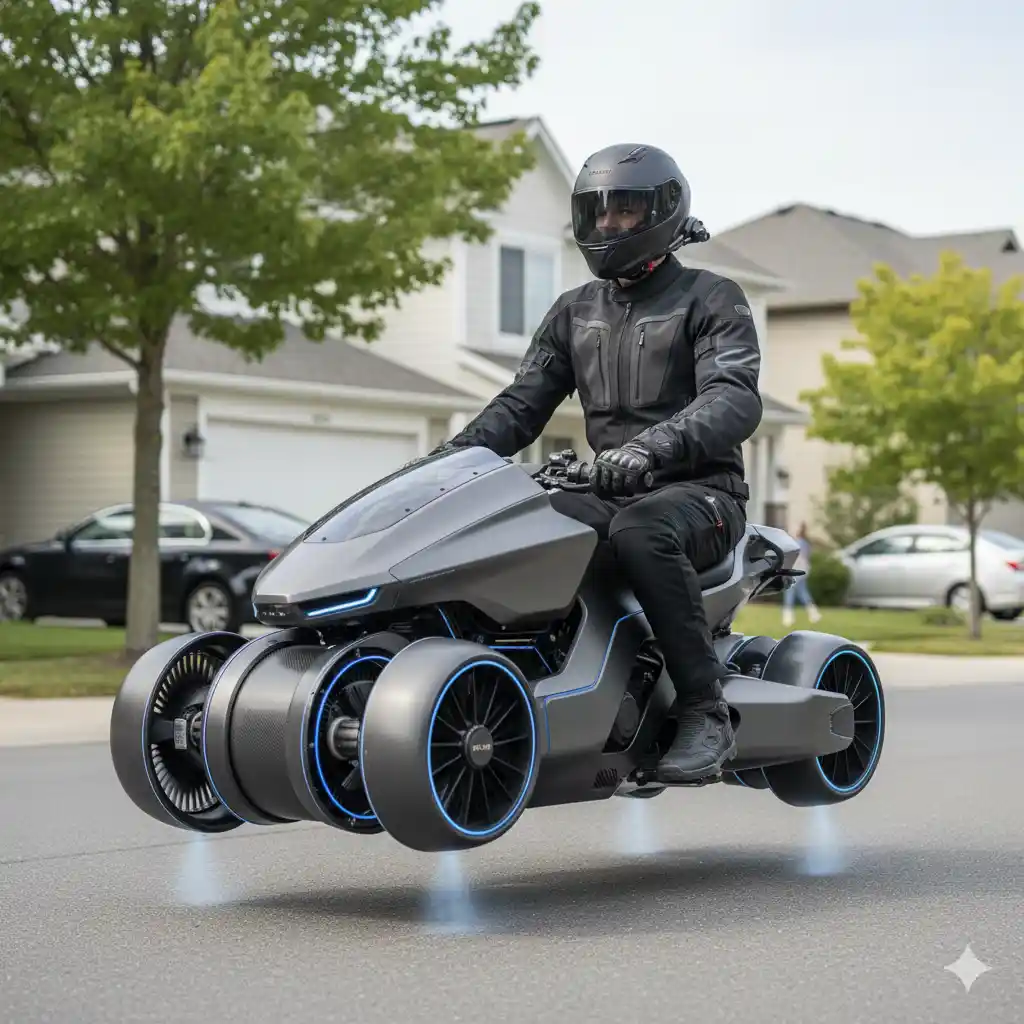
Part of our Gadget Tech Fundamentals: The Complete Guide guide. For decades, the hoverbike has lived solely in the realm of science fiction—a staple of films...
Part of our Gadget Tech Fundamentals: The Complete Guide guide.
For decades, the hoverbike has lived solely in the realm of science fiction—a staple of films like Star Wars and Back to the Future. But today, this fantasy is rapidly becoming a reality. Companies around the globe are pushing the limits of eVTOL (electric Vertical Take-Off and Landing) technology to deliver a machine that promises to eliminate traffic, conquer any terrain, and redefine personal transportation.
At TopTech Compare, we dive into the engineering, the economics, and the reality of the hovering motorcycle—the world’s most ambitious personal gadget.
The Tech Under the Hood: Propellers vs. Jets
Hoverbikes are not all built the same. They generally fall into two main categories, each with its own advantages and drawbacks:
1. Ducted Propeller Systems (The Drone Approach)
- How it Works: Similar to a large drone, these bikes use multiple propellers (typically four to six) enclosed in protective ducts. These ducts increase lift efficiency and, crucially, protect the rider and bystanders from the spinning blades.
- Key Players: The A.L.I. Technologies XTURISMO (Japan) and Hoversurf’s Scorpion/S3 (used by the Dubai Police) are prime examples.
- Specs Snapshot (XTURISMO): Can reach speeds of around $100 text{ km/h}$ and hover for about 30-40 minutes.
- The Advantage: Proven stability via sophisticated flight controllers, making them easier to manage than traditional helicopters.
2. Jet Propulsion Systems (The Star Wars Speeder)
- How it Works: These newer concepts ditch propellers for redundant jet turbines, often using diesel or Jet-A1 fuel. This allows for a much lighter, more compact design and higher speeds.
- Key Players: The Volonaut Airbike (Poland) is an emerging concept, claiming a top speed of over $200 text{ km/h}$.
- The Advantage: Minimal footprint and greater top speed, embodying the true spirit of a futuristic flying bike. The lack of large exposed propellers makes them potentially safer in crowded airspaces (if regulations ever allow).
Hoverbike vs. Superbike: The Critical Comparison
| Feature | Modern Superbike (e.g., Ducati Panigale) | Hovering Motorcycle (e.g., XTURISMO) |
| Terrain Capability | Restricted to paved roads/tracks. | Unrestricted. Can traverse water, sand, mountains, and traffic. |
| Top Speed | 250 km/h} – 320 km/h | Typically100 km/h – 200 km/h |
| Range/Endurance | Hundreds of kilometers (gas/large battery). | Limited: Typically 10-40 minutes of flight time. |
| Fuel/Power | Gasoline or high-density lithium batteries. | High-power batteries, hybrid-electric, or jet fuel. |
| Licensing/Regulation | Standard motorcycle license, road registration. | Highly Ambiguous. Often classified as an ultralight aircraft (requires no license in some areas) but faces severe airspace restrictions. |
The Real-World Roadblocks to Mass Adoption
While the technology is undeniably cool, there are major hurdles preventing hoverbikes from becoming your next commuter vehicle:
1. Battery and Range Limitations
This is the single biggest challenge. To lift a pilot and the vehicle’s considerable weight, the power consumption is enormous. Even with high-density LiPo batteries, flight time remains severely limited—often under 40 minutes—making them impractical for anything but short, high-speed hops.
2. Safety and Redundancy
Unlike a car, if a propulsion system fails mid-flight, the results are catastrophic. Hoverbikes require multiple layers of electronic and mechanical redundancy (redundant flight controllers, multiple motors) to ensure safe emergency landings, which adds complexity and cost.
3. Regulation and Airspace Management
Who governs the sky at 10 feet? The FAA (or equivalent bodies globally) is still developing frameworks for personal eVTOLs. Without clear laws on altitude, air traffic control, and mandatory training, mass adoption in dense urban areas is impossible due to the risk of mid-air collisions.
4. Noise Pollution and Cost
The roar of high-powered electric motors or small jet turbines generates significant noise, making them unpopular with communities. Furthermore, the combination of exotic materials (carbon fiber), proprietary motors, and complex flight computers keeps the price firmly in the millionaire’s toy category.
The Verdict from TopTech Compare
The hovering motorcycle is one of the most exciting advancements in personal mobility, a true fusion of motorcycle agility and helicopter freedom. However, for the average consumer, it remains a decade or more away.
For now, these incredible machines are limited to niche B2B applications—such as emergency response, remote inspection, or specialized military/police use (like the Dubai Police)—where cost and limited flight time are secondary to the unique capability of bypassing ground obstacles entirely.
The dream of commuting over traffic on your own personal speeder is alive, but it will require a breakthrough in solid-state battery technology or a complete overhaul of urban airspace laws before it becomes a common sight above our streets.