Honor Magic V5: Pushing Foldable Phones Toward Slab-Phone Thinness
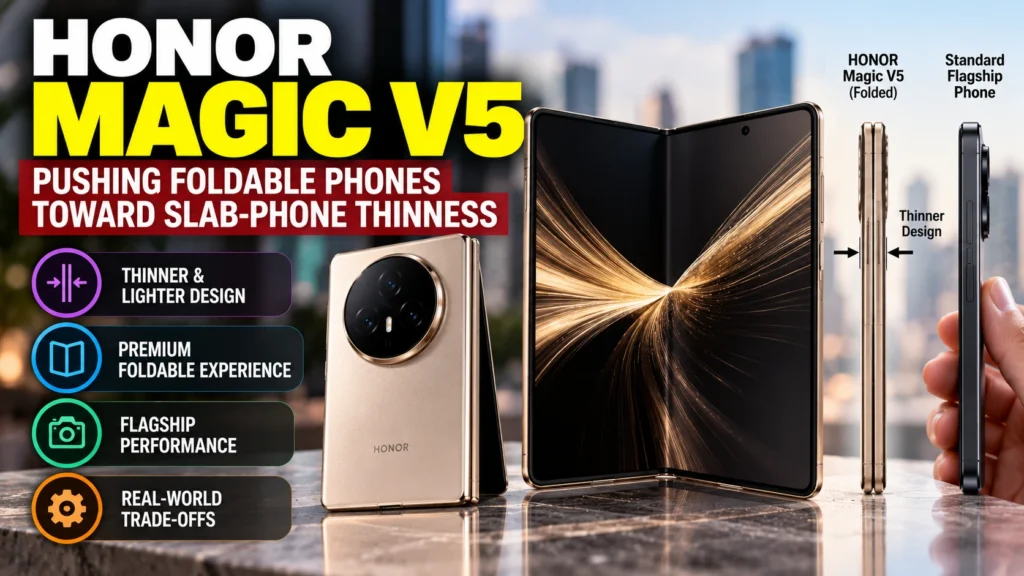
How the Honor Magic V5 pushes foldable phone thinness and durability forward, and how it compares against Samsung's own book-style foldable.
The Honor Magic V5 continues Honor’s Magic V foldable smartphone line, distinguishing itself within the growing book-style foldable phone category primarily through its emphasis on achieving a thinner, lighter folded form factor than most competing foldables, directly challenging the persistent perception that foldable phones must be noticeably bulkier than standard non-folding flagships.
Why Folded Thinness Has Become Honor's Signature Foldable Focus
Honor has specifically prioritized minimizing the Magic V line’s folded thickness and overall weight across successive generations, an engineering focus that’s addressed one of book-style foldable phones’ most persistent practical criticisms, that they tend to feel noticeably bulkier and heavier in the pocket compared with a standard non-folding flagship phone, with the Magic V5 continuing to push this thinness engineering further than many competing foldables have achieved.
The Genuine Trade-offs Book-Style Foldables Still Involve
Despite Honor’s thinness improvements, book-style foldable phones like the Magic V5 still involve inherent trade-offs common to the entire foldable category, including a visible crease along the inner display’s fold line that remains detectable, even if reduced, compared with a standard rigid display, and a hinge mechanism that adds mechanical complexity and a potential long-term durability consideration that traditional non-folding phones simply don’t need to address.
Inner and Outer Display Configuration
Like other book-style foldables, the Magic V5 features a smaller outer cover display usable when the phone is folded closed for quick everyday tasks, and a larger inner display that unfolds to a size closer to a small tablet, ideal for multitasking, media consumption, and productivity tasks that benefit from additional screen real estate, a dual-display configuration that represents the core practical value proposition book-style foldables like the Magic V5 offer over standard single-display flagship phones.
How Honor Positions Against Samsung's Galaxy Z Fold Line
The Honor Magic V5 competes most directly against Samsung’s Galaxy Z Fold line, the most globally established book-style foldable, with independent comparisons generally finding Honor’s specific advantage lies in its thinner, lighter folded form factor, while Samsung has generally maintained advantages in broader software optimization specifically for foldable multitasking and wider global brand recognition and distribution within the still-developing foldable phone category.
Foldable Phones' Continued Position as a Growing But Niche Category
Despite genuine engineering progress from Honor, Samsung, and other foldable manufacturers, foldable phones including the Magic V5 remain a meaningfully smaller, more premium-priced category compared with mainstream standard-format flagship phones, appealing specifically to buyers who value the productivity and multitasking benefits of a larger unfolding display enough to accept the category’s still-present trade-offs around price, crease visibility, and long-term hinge durability considerations.
Bottom Line
The Honor Magic V5 continues pushing book-style foldable phone engineering forward specifically through its emphasis on achieving a thinner, lighter folded form factor than most competing foldables, directly addressing one of the category’s most persistent practical criticisms. It remains a genuinely compelling option within the growing but still relatively niche foldable phone category, competing most directly against Samsung’s more globally established Galaxy Z Fold line.
Sources
- Honor official Honor Magic V5 product specifications and feature documentation
- Independent foldable phone thinness and durability testing from major tech outlets
- Comparative book-style foldable phone analysis from GSMArena and Android Authority
- Foldable phone hinge durability and long-term reliability technical analysis