Know Smartphone Camera Sensor: Why Size Beats Megapixels in 2026
Smartphone Camera Sensor is an integral part of any Phone these days. Rarely you will see a phone in 2026 without a camera in 2026. Every...
Smartphone Camera Sensor is an integral part of any Phone these days. Rarely you will see a phone in 2026 without a camera in 2026.
Every phone launch these days leads with a camera number. Two hundred megapixels here, a large sensor there, and a spec sheet full of figures meant to convince you this year’s phone takes better photos than last year’s.
The smartphone camera sensor is the actual part doing the work behind all of that, and once you understand what it is and how it behaves, the marketing gets a lot easier to read.
What a Smartphone Camera Sensor Actually Does
A camera sensor is a small chip covered in millions of light sensitive points called photosites.
When light passes through the lens and hits the sensor, each photosite records how much light landed on it, and that data becomes a pixel in the finished photo.
A 50 megapixel sensor has roughly 50 million of these photosites packed onto a surface that, on most phones, is smaller than a fingernail.
Sensor Size Is the Number That Actually Matters
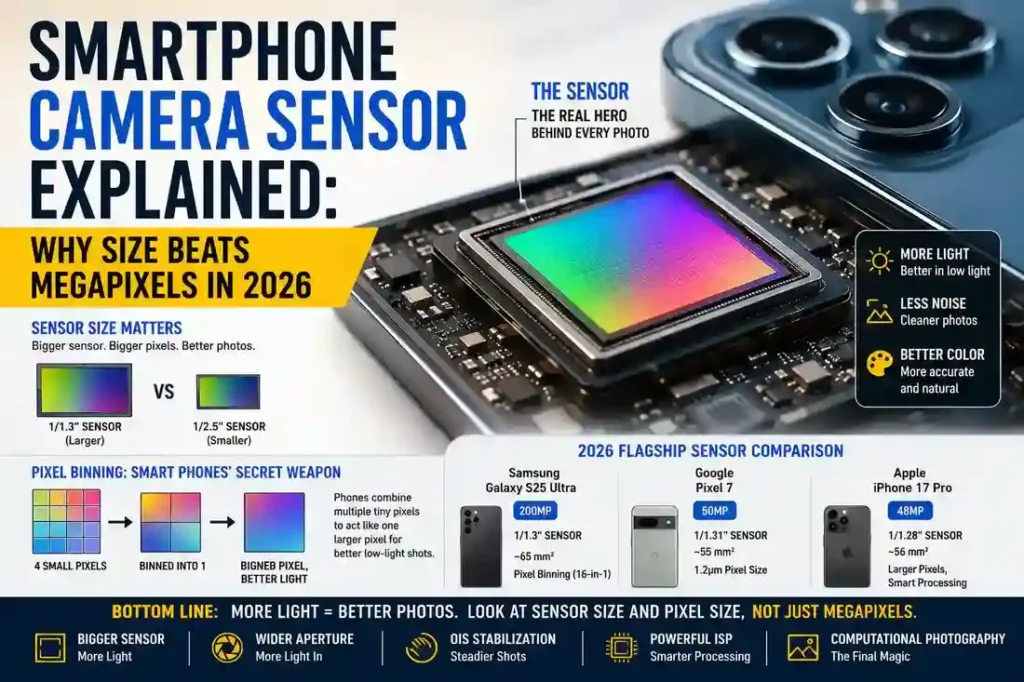
Megapixel count tells you how many photosites sit on the sensor. It says almost nothing about how big each one is, and pixel size is what actually determines how well a camera performs once the light gets low.
Larger photosites collect more light per shot, which means less noise, cleaner shadows, and more accurate color in a dim restaurant or at dusk.
A 12 megapixel sensor with large pixels can comfortably outperform a 108 megapixel sensor with tiny ones in exactly the conditions where photos usually go wrong.
This is why photographers and camera reviewers talk about sensor size in fractions like 1/1.3 inch or 1/2 inch rather than megapixels alone.
The number refers to the physical width of the sensor relative to an old video camera format, and despite the confusing notation, bigger is genuinely better.
The iPhone 17 Pro’s main sensor measures roughly 1/1.28 inch, which sounds tiny next to a professional camera but is large by phone standards.
Even so, it remains about 37 times smaller in surface area than a full frame sensor found in a professional mirrorless camera, according to sensor comparisons published by Amateur Photographer Guide.
That gap is exactly why phone cameras lean so heavily on software to close the distance with dedicated cameras.
Pixel Binning: How Phones Fake Bigger Pixels
Most high megapixel phone sensors do not actually shoot at their full resolution for everyday photos.
Instead they use a technique called pixel binning, which groups several small photosites together and treats them as one larger effective pixel.
The Samsung Galaxy S23 main sensor uses 1 micron pixels individually across its 50 megapixels, but by binning four of them together it outputs 12.5 megapixel photos with an effective pixel size closer to 2 microns, which noticeably improves low light shots.
The more extreme 200 megapixel sensors found on phones like the Galaxy S25 Ultra go further still, binning groups of sixteen photosites into one during normal shooting and only using the full 200 megapixel resolution when a user deliberately chooses it for cropping or fine detail.
The lesson here matters more than any single spec.
A phone advertising 200 megapixels is not actually taking 200 megapixel photos most of the time, and that is by design.
The real story is how intelligently the phone manages that pixel data, not the raw count printed on the box.
How 2026 Flagship Sensors Actually Compare
Looking at current flagship sensors side by side tells you more than any spec sheet headline.
The Galaxy S25 Ultra’s 200 megapixel main sensor sits at 1/1.3 inch, giving it a sensor area of around 65 square millimeters, which is enormous by phone standards but still a fraction of what a full frame camera captures.
Google’s approach with the Pixel line has leaned toward moderate resolution and larger individual pixels, with the Pixel 7’s 50 megapixel sensor using 1.2 micron pixels tuned heavily through computational processing rather than raw hardware size.
Apple has generally favored a similar philosophy, prioritizing pixel size and image processing over chasing the highest megapixel number on the spec sheet.
None of this means megapixels are meaningless.
More photosites genuinely help when a photo needs deep cropping or fine texture in bright daylight, which is why sensor size and resolution both play a role depending on what someone actually photographs.
| Smartphone | Main Camera Resolution | Sensor Size | Pixel Size / Binning | Main Advantage |
|---|---|---|---|---|
| Samsung Galaxy S25 Ultra | 200 MP | 1/1.3-inch | 16-in-1 pixel binning | High resolution and strong cropping/detail |
| Google Pixel 7 | 50 MP | 1/1.31-inch | 1.2 μm pixels | Computational photography and image processing |
| Apple iPhone 17 Pro | 48 MP | 1/1.28-inch | Larger pixels | Light gathering and computational photography |
| Full-Frame Camera | Varies | Full frame | Much larger photosites | Far greater light capture and image quality potential |
What Actually Makes a Phone Camera Good
Sensor size and pixel size explain a lot, but they are only part of the picture.
Aperture, which controls how much light reaches the sensor in the first place, optical image stabilization, which compensates for hand shake during longer exposures, and the image signal processor that turns raw sensor data into a finished photo all shape the final result just as much as the sensor itself.
Two phones with nearly identical sensors can produce very different photos depending on how aggressively each brand tunes its computational photography pipeline.
At Top Tech Compare, this is the lens worth bringing to every camera comparison: specs explain the hardware, but real world samples across different lighting conditions show what a phone actually does with that hardware.
Anyone shopping by spec sheet alone should hunt down sensor size and pixel size before getting distracted by the megapixel headline.
2026 Camera Sensor Comparison: Size vs. Megapixels
| Camera Spec | What It Tells You | Why It Matters |
|---|---|---|
| Megapixels | Number of photosites | Useful for cropping and fine detail |
| Sensor Size | Physical area capturing light | Larger sensors generally capture more light |
| Pixel Size | Size of individual photosites | Larger pixels can reduce noise in low light |
| Aperture | Amount of light entering the lens | Wider apertures help in darker conditions |
| OIS | Stabilization during exposure | Reduces blur from hand movement |
| ISP / Processing | How raw data becomes the final image | Strong processing can dramatically improve results |
Bottom Line
A bigger megapixel count is not the same thing as a better camera.
Sensor size and pixel size determine how much light a phone can gather, which is the single biggest factor in photo quality, especially indoors or after sunset.
When comparing phones, look past the megapixel number and check the sensor size, then weigh that against aperture, stabilization, and how the phone processes its images.
Sources
– GSMArena specifications database and manufacturer press releases, 2025 to 2026
– Amateur Photographer Guide, camera sensor size comparison
– Android Police, smartphone camera sensor explainer
– Reviewed, 200MP camera phone explainer, 2026