
Tesla’s “Flying Car”: How the Roadster Leaves the Ground, and What It Can’t Yet Do
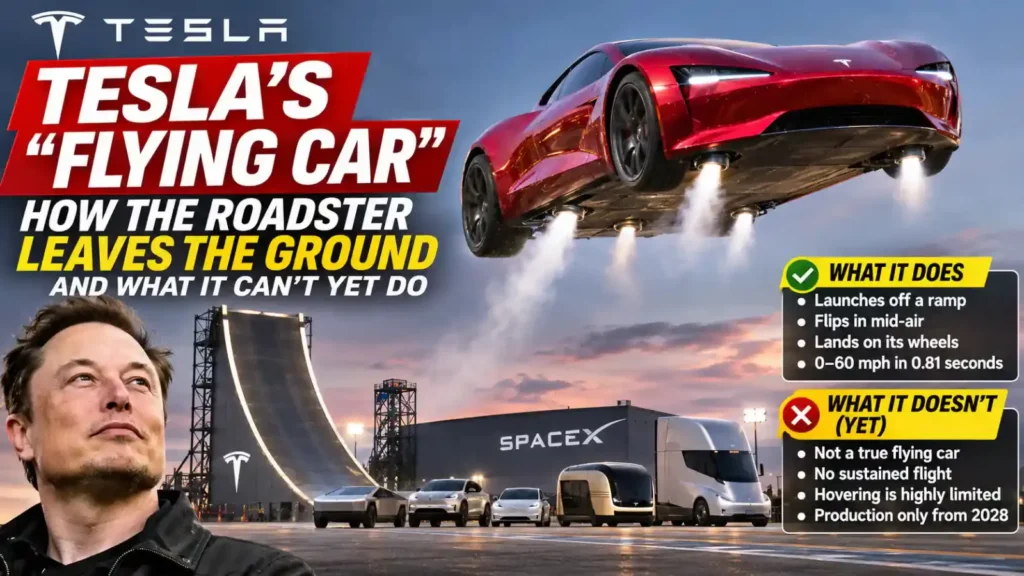
On October 15, 2026, Elon Musk showed the world a Tesla that flies. Or, more precisely, a Tesla that launches itself off a ramp, flips in...
On October 15, 2026, Elon Musk showed the world a Tesla that flies. Or, more precisely, a Tesla that launches itself off a ramp, flips in mid-air and lands on its wheels using bursts of compressed air. The distinction matters, and understanding it is the best way to understand the technology which is making inroads int he world today.
What we have witnessed on October 15 was nothing less than a science fiction novel coming to real life.
By now, the tech freaks have discovered why Elon Musk kept the time of inauguration of these flying cars at around 7:55, which reads as 19:55. That was also the date on which Marty McFly went into the past in the movie Back to the Future.
What Tesla actually showed
The event took place at a SpaceX test site in McGregor, Texas, near Waco. It had been postponed about two weeks earlier because of bad weather, which only fed speculation that SpaceX hardware was involved.
The demonstration had two parts:
-
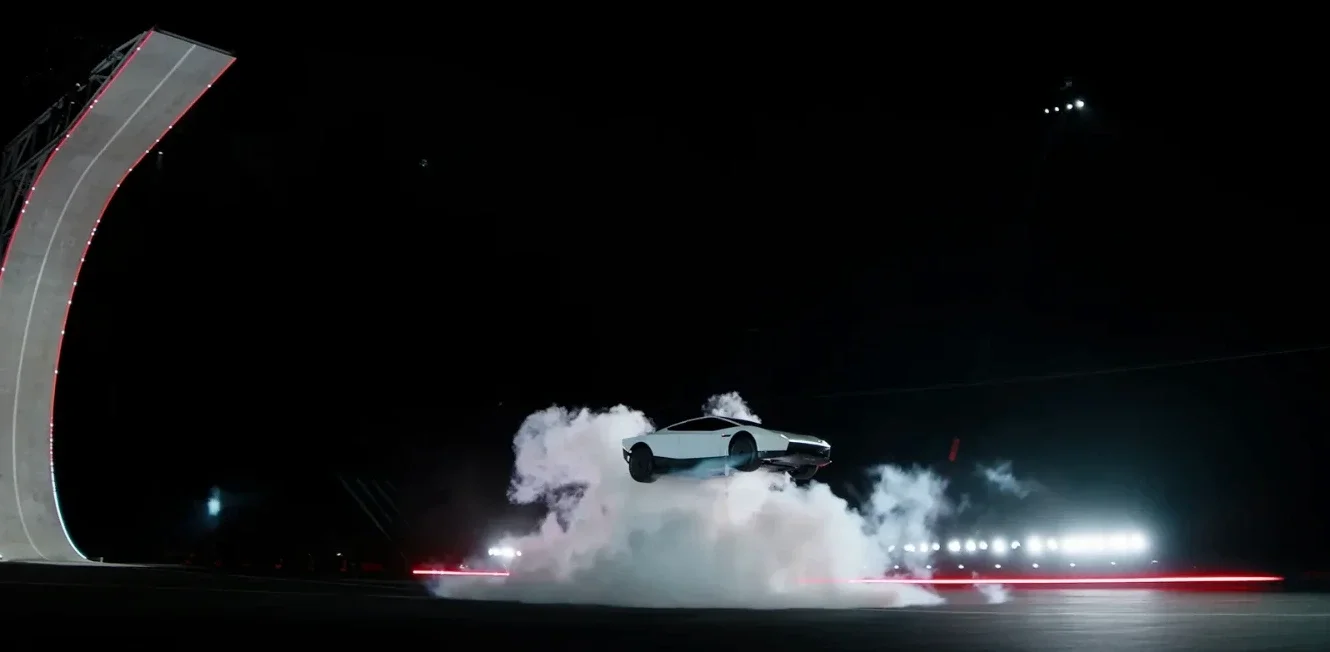
The upside-down ramp. The new Roadster drove up a tall, curved ramp shaped like half of an inverted loop. A fan-based suction system held it against the surface, even upside down, until it left the end of the ramp. Thrusters then rolled it upright and it landed on the tarmac.
-
The jump. The car fired its thrusters to clear a line of Tesla vehicles, including a Cybercab, Cybertruck, Semi, Model Y and Model 3, rotating in the air before a thruster-assisted landing.
Tesla also reported a 0 to 60 mph time of 0.81 seconds in a live test, and said production would start in 2028.
The technology behind it
1. Cold-gas thrusters from SpaceX
The “rocket” in this Roadster is not a rocket engine in the usual sense. Nothing burns. According to Tesla’s engineering VP Lars Moravy, the car has 10 thrusters fed by about 600 litres of compressed air, stored in carbon-fibre-wrapped pressure vessels packed into every usable space in the car. The tanks can be recharged, so no special propellant is needed.
A cold-gas thruster works on Newton’s third law. It opens a valve, let high-pressure gas escape through a nozzle, and the reaction pushes the vehicle the other way. Spacecraft have long used this method for attitude control because it is simple and precise. The Roadster borrows the idea, with thrusters arranged to push and to rotate the car.
Musk first floated this in 2018, when he said a “SpaceX option package” would add roughly ten small rocket thrusters arranged around the car.
2. Suction fans for grip
The fan system is what let the car cling to the ramp. Reports describe a downforce of up to about 2G, meaning grip well beyond what tyres alone provide. It also helps explain the extreme acceleration claim, since grip limits how hard a car can launch.
3. Carbon structure and pressure vessels
Reports said Musk chose a carbon-fibre tub for the car and wanted it to evoke the SR-71 Blackbird. Carrying 600 litres of high-pressure air safely requires pressure vessels that are both light and strong, a technology SpaceX uses in its rockets (and one that has been involved in some of its rocket failures, which is a reminder of the risks).
4. Control
A flip and a controlled landing need fast sensing and thruster control, much like spacecraft attitude control. Tesla has not published the control design.
Is it a flying car?
Not in the sense most people mean. Here is the honest picture:
-
Short bursts, not sustained flight. Compressed air runs out quickly. One independent back-of-envelope estimate suggests a hover from a tank of this kind would last only seconds, though that is an outside estimate, not a Tesla figure.
-
Hovering is hard. A roughly 1,500 to 2,000 kg car needs upward thrust of about 15 to 20 kilonewtons just to hold still in the air, continuously.
-
What was flown may not be what is sold. Reports suggest the demo vehicles may have been remote-operated or empty, and that the original plan, including a more ambitious hover, was scaled back. Tesla’s own materials describe the full flight system as belonging to an invite-only single-seat “Rocket” variant.
-
Production is years away. Deposits are open (reported at $50,000 for the Performance version and $250,000 for the Thrust version, which adds acceleration thrusters), but delivery is slated for 2028, and Musk’s timelines have slipped before.
For true sustained flight, the proven route is not rockets but electric rotors, as in eVTOL aircraft. Rotors push the surrounding air downward, so they don’t have to carry their working fluid, and large rotors are far more efficient at hovering than small jets of stored gas. The trade-off is battery weight and certification.
Why it matters anyway
The Roadster is better understood as a very fast, very capable car that uses spacecraft techniques for stunts and acceleration. Even so, it shows how aerospace components (pressure vessels, thrusters, control systems) are moving into cars. Whether that becomes safe, legal, everyday transport is a separate question, and regulators will want evidence well beyond a demo.
Status as of October 17, 2026. Details come from news reports of the event and may change as Tesla releases more information.
Sources
-
Tesla reveals SpaceX-powered Roadster that flies and falls with style (TechCrunch)
-
Tesla’s new Roadster makes a flying debut (Fox Business)
-
Tesla Roadster Event Recap: It Flies, Flips, and Hits 0-60 in 0.81s (Not a Tesla App)
-
Tesla’s Flying Roadster Has Wall Street Talking About SpaceX, Not Cars (Motley Fool)
-
Tesla’s Flying Roadster: What Was Shown, How Cold-Gas Thrusters Work, What Is Unproven (ExplainX)
-
Tesla ‘flying’ Roadster demo could come this month, with no one inside (Electrek)
